
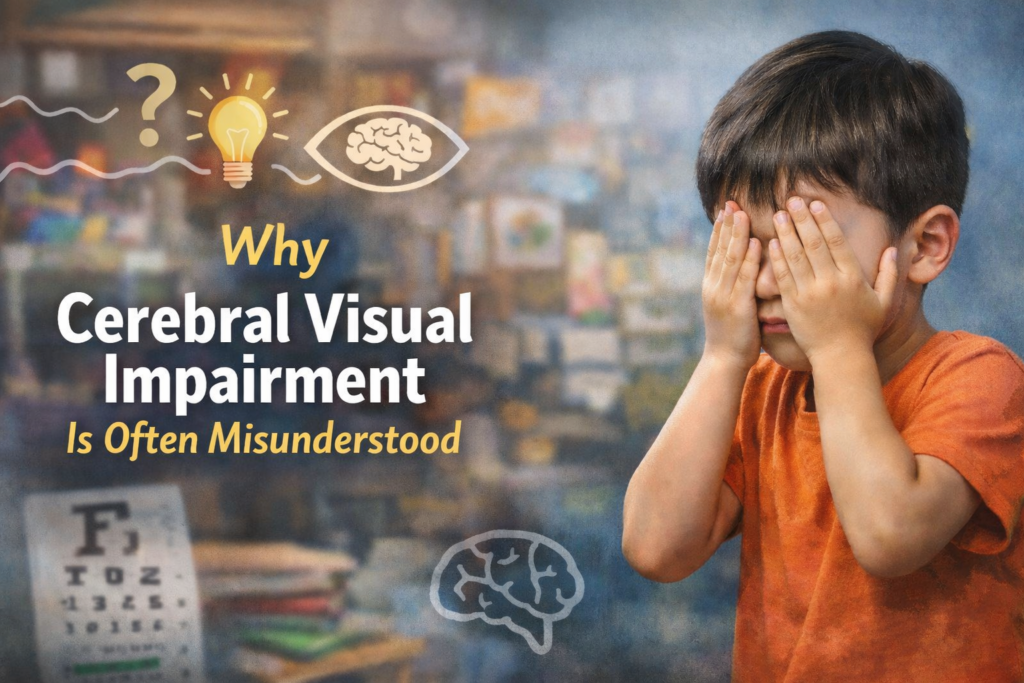
Children with Cerebral Visual Impairment, or CVI are frequently described as inconsistent.
They may appear attentive in one setting and disengaged in another. They may recognise familiar objects one day and struggle the next. These variations are often misunderstood as behavioural concerns or developmental delay.
In reality, they may reflect neurological visual processing differences.
Understanding this distinction is critical for parents, educators, and healthcare professionals in Malaysia, where structured pathways for identification and intervention are still developing.
Visual Complexity and Processing Overload
One of the most significant yet under-recognised aspects of CVI is sensitivity to visual complexity.
The brain must constantly filter and prioritise visual information. In children with neurological visual processing differences, this filtering system may be less efficient.
Visually complex environments can include:
• Patterned backgrounds
• Cluttered play spaces
• Busy classrooms
• Multiple objects presented at once
• Competing colours and lighting
When too many elements compete for attention, the brain may struggle to determine what is important.
This can result in:
• Looking away
• Fatigue
• Delayed responses
• Reduced engagement
• Apparent inattention
Research indicates that reducing visual complexity can significantly improve functional engagement in children with neurological visual impairment (Dutton & Bax, 2010).
Why Early Recognition Matters
When CVI is not recognised early, children may be mislabelled or placed in environments that increase visual overload.
Evidence suggests that structured environmental adaptations and targeted strategies can significantly improve functional outcomes (Sakki et al., 2018; Boot et al., 2010).
Early recognition allows for:
• Simplified visual presentation
• Adapted learning materials
• Improved safety in navigation
• Reduced frustration
• Better collaboration between caregivers and professionals
The earlier adjustments are made, the greater the potential impact on developmental trajectory.
References
Dutton, G. N., & Bax, M. (2010). Visual impairment due to disorders of the brain in children. Developmental Medicine & Child Neurology.
Boot, F. H., Pel, J. J. M., van der Steen, J., & Evenhuis, H. M. (2010). Cerebral visual impairment: Which perceptive visual dysfunctions can be expected in children? Journal of Intellectual Disability Research.
Sakki, H. E. A., Dale, N. J., Sargent, J., & Perez-Roche, T. (2018). Is there consensus in defining childhood cerebral visual impairment? British Journal of Ophthalmology.